Structured Outputs, Evidence, and Freshness

Home · Knowledge and Agents · Reports, AI Log, and Traceability

Agents View

Objective

This page explains how to interpret a structured output in ProPM Agent to decide whether the result is directly usable, needs review, or should be transformed into a governed artifact.

Why It's Important

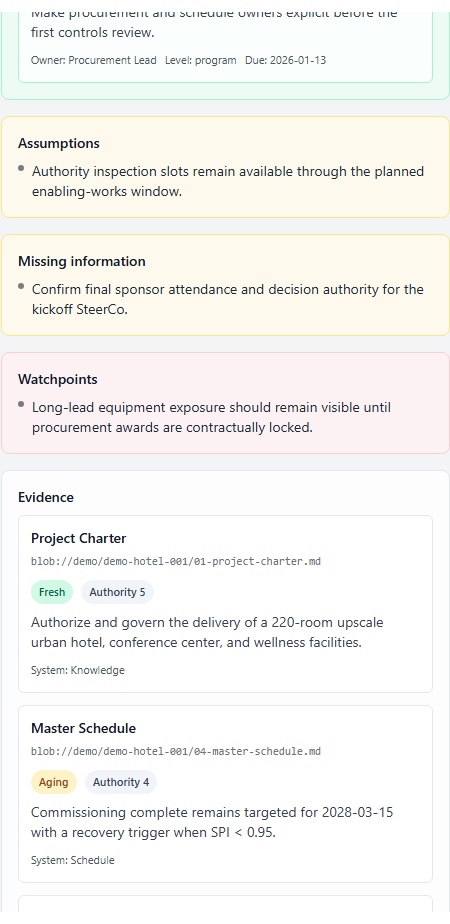
ProPM Agent does not return only free text. Observed runs can additionally expose:

  • a summary;
  • findings;
  • decisions needed;
  • actions;
  • assumptions;
  • missing information;
  • watchpoints;
  • evidence;
  • metadata for freshness and confidence;
  • artifact proposals, follow-ups, and notifications.

Where This Information Appears

Structured outputs and their metadata are visible in several surfaces:

  • Agents, immediately after a run;
  • AI Log, in the detail of a run;
  • Reports & Artifacts, via the lineage between run, artifact, and PM Doc.

Example of a structured output in the project workspace

How to Read a Structured Output

  1. Read the Summary;
  2. Then open Decisions needed or Actions;
  3. Check the Evidence section;
  4. Review the Confidence and Source freshness;
  5. Then decide whether the response can remain in the chat, become a draft artifact, or require human review.

Meaning of Sections

SectionWhat It's For
SummaryShortest version of the result, ready for quick review
FindingsFacts, reasons, or observations highlighted by the run
Decisions neededPoints requiring human arbitration
ActionsRecommended follow-ups to execute or plan
AssumptionsImplicit conditions the response depends on
Missing informationMissing information that reduces the robustness of the result
WatchpointsRisks, contradictions, or subjects to monitor
EvidenceReferences serving as proof or justification
Artifact status / Artifact proposalsIndications on the possible transformation of the result into a governed artifact
Follow-upsProposed continuation steps
NotificationsDrafts or notifications suggested by the flow

Simplified Reading Example

The example below is illustrative. It serves to show how to review a structured card before reuse:

  • Summary: The critical batch appears to be two weeks late.
  • Findings: The latest planning note is more recent than the governed calendar connector.
  • Decisions needed: Should the sponsor milestone be rebaselined or should a planning revalidation be requested?
  • Evidence: Planning note, excerpt from weekly report, state of the source connector.
  • Source freshness: Knowledge fresh, planning connector stale.
  • Watchpoints: Possible contradiction between project communication and the latest synchronized data.

Recommended reading in this case:

  1. The Summary tells you what to review first;
  2. The combination Evidence + Source freshness prevents you from publishing too quickly;
  3. The presence of a Watchpoint and a decision to take pushes towards human review, then towards an artifact if the subject becomes formal.

Two Common Cases to Distinguish

CasePractical ReadingRecommended Decision
Correct confidence but insufficient freshnessThe reasoning seems coherent, but part of the sources is stale or agingDo not disseminate without revalidation or documentary refresh
Low confidence but recent sourcesThe sources are recent, but the run still reports gaps, contradictions, or overly strong assumptionsKeep the output as exploratory work, then relaunch the review or the run before formalizing

This distinction avoids treating confidence as a single score. A response can seem solid while relying on outdated sources, or vice versa.

How to Read Evidence

Each piece of evidence or citation can expose several useful elements:

  • a title or source name;
  • a source URI or documentary name;
  • a snippet;
  • a page or section when available;
  • a sync date;
  • a source system;
  • a freshness badge;
  • an authority rank when exposed.

What to Check Before Reusing Evidence

  1. Does the snippet properly support the displayed message?
  2. Is the source identifiable and reopenable?
  3. Is the freshness acceptable for the expected decision level?
  4. Do multiple pieces of evidence tell the same story, or is there contradiction?

Freshness States

StatePractical MeaningRecommended Reaction
freshSource sufficiently recent for normal useCan be reused after normal review
agingSource still usable but approaching a need for revalidationCheck quickly before broad dissemination
staleSource too old to be considered reliable without additional controlRefresh, reimport, or confirm before decision
conflictingThe source contradicts another relevant sourceDo not arbitrate automatically; review the evidence
unavailableThe source could not be confirmed or retrievedTreat as an alert, not as usable evidence

Confidence

Confidence is a global signal of the result's robustness. It must be interpreted with freshness and evidence, never isolated.

Plan for additional human review if you see:

  • low confidence;
  • absent or non-specific evidence;
  • stale, conflicting, or unavailable states;
  • significant Missing information section;
  • decision or action with external impact.

Review Level Based on Impact

Impact LevelMinimum ReviewRecommended Escalation
Internal work draftCheck Summary, Findings, and at least one reopenable piece of evidenceKeep the output in the chat if it remains exploratory
Team coordination or internal project actionCheck evidence, freshness, missing information, and proposed actionsCreate an artifact if the result must be shared or archived
Sponsor decision, publication, external notification, or governed actionReview all evidence, arbitrate conflicting / stale states, retain technical IDsGo through Reports & Artifacts, the diff, the lineage, and the AI Log before dissemination

Traceability IDs to Keep

FieldUsage
Trace IDLocate precisely the run or event for support
Structured output IDIdentify the structured output actually produced
Context snapshot IDUnderstand in which documentary or project context the run executed

These fields are particularly useful when you need to reconcile a run, an artifact, and an event from the AI Log.

When to Transform the Output into an Artifact

The typical observed path is:

  1. Project question;
  2. Structured response;
  3. Creation of a draft artifact;
  4. Review of the diff and lineage;
  5. Approval or publication.

Transform an output into an artifact when:

  • It must become a formal deliverable;
  • It must go through validation or publication;
  • You need to maintain explicit lineage to a run and its evidence;
  • The content must leave the chat for external dissemination, approval, or durable traceability.

Simple rule: While exploring, the chat may suffice; as soon as a result must be shared, approved, published, or kept as a trace, go through Reports & Artifacts.

Checklist Before Reuse in a Deliverable

  1. Does the summary accurately match the detailed findings?
  2. Are the proposed actions consistent with the project situation?
  3. Is the evidence sufficiently precise to justify the decision?
  4. Are the freshness states acceptable?
  5. Should an artifact be created or is keeping the output in the chat sufficient?

Common Issues

The Response Seems Clean but No Evidence Appears

Treat the result as an item to review before external use. The absence of visible evidence reduces the ability to justify the content.

Evidence is conflicting

Do not publish directly. Open the source, compare the conflicting references, and document the arbitration in the artifact or in governance. If the subject requires a formalized decision, proceed to Governance, Decisions, and Actions rather than leaving the conflict solely in the chat.

Evidence is unavailable

Consider that the justification is not stabilized. Check the source in Knowledge, the import, or the run detail in AI Log.

Next